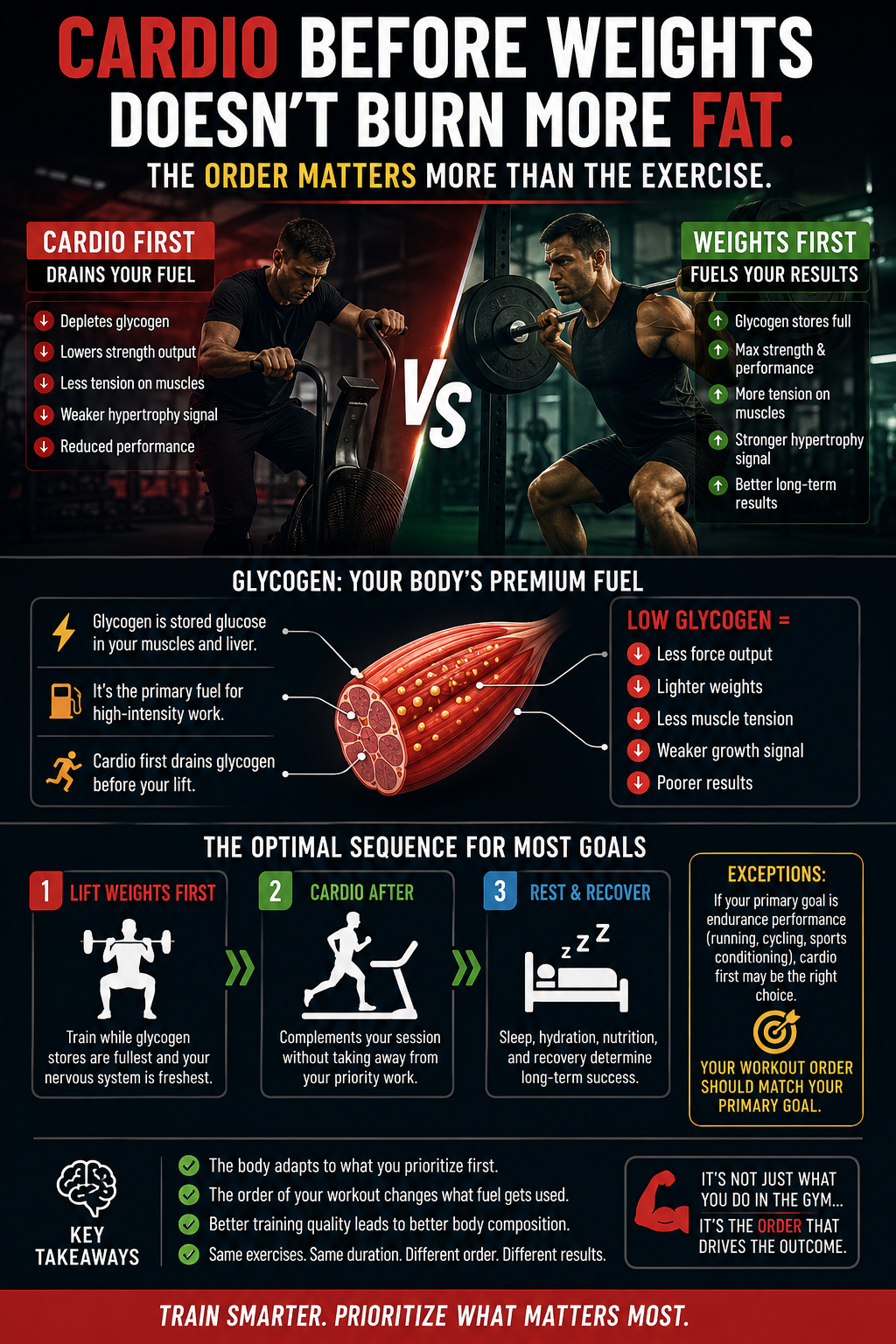
Cardio Before Weights?
One of the most common gym habits is also one of the most misunderstood:
People walk into the gym, jump on a treadmill or bike first, burn through 20–30 minutes of cardio… and then move to the weights.
Most believe this helps burn more fat.
But if your goal is improving body composition, preserving muscle, building strength, or maximizing fat loss results, the order of your workout may matter far more than most people realize.
The Body Adapts to What You Prioritize First
Your body responds to the first major stressor you place on it during a workout.
Cardio first = your body prioritizes endurance
Weights first = your body prioritizes strength and muscle output
That doesn’t mean cardio is “bad.” Far from it.
Cardio is excellent for:
Heart health
Lung capacity
Circulation
Endurance
Recovery
Overall longevity
The issue isn’t whether cardio should be done.
The issue is when.
Glycogen: Your Body’s Premium Training Fuel
Your muscles rely heavily on glycogen during intense exercise.
Glycogen is stored carbohydrate energy found primarily in your muscles and liver. It’s the fuel source your body prefers during:
Heavy lifting
Explosive movements
High-intensity training
Progressive overload work
When you perform cardio before lifting, especially moderate-to-high intensity cardio, you begin draining that fuel supply before your resistance training session even starts.
Then you ask your muscles to produce maximum force with reduced available energy.
That matters.
Less Glycogen = Less Performance
When glycogen levels drop:
Force production decreases
Strength output decreases
Training intensity decreases
Total volume often decreases
And that creates a chain reaction:
Less force output
Lighter weights used
Less tension placed on muscle fibers
Weaker hypertrophy signal
Reduced training stimulus overall
In simpler terms:
Your workout quality suffers before the part of the session that actually builds and preserves muscle.
Why This Matters for Fat Loss
Here’s the irony:
Many people perform cardio first because they think it improves fat burning.
But improved body composition is heavily influenced by:
Maintaining or building lean muscle
Creating strong resistance training stimulus
Increasing metabolic demand over time
Preserving training performance during calorie deficits
If cardio first reduces the quality of your lifting session, it may work against the very goal you’re chasing.
Research has shown that performing cardio before resistance training can significantly reduce lower-body strength performance during the workout that follows.
That doesn’t mean cardio ruins gains.
It means sequencing matters.
So What’s the Best Order?
For most people whose goals are:
Fat loss
Muscle retention
Muscle building
Improved body composition
Strength development
The ideal sequence is usually:
1. Lift Weights First
Train while glycogen stores are fullest and your nervous system is freshest.
2. Perform Cardio After
At this point, the priority work is done, and cardio can complement the session instead of competing with it.
3. Recover Properly
Sleep, hydration, nutrition, and recovery still determine long-term success.
Does This Mean Cardio Should Always Come Second?
Not necessarily.
If your primary goal is:
Endurance performance
Distance running
Cycling
Sport-specific conditioning
Then cardio first can absolutely make sense because you should prioritize the quality of the adaptation you care about most.
The key takeaway is simple:
Your workout order should match your primary goal.
Final Thoughts
Most people focus on:
Which exercises to do
Which machines to use
Which supplements to buy
But often the bigger issue is workout structure.
One small change in exercise order can dramatically influence:
Energy availability
Performance quality
Strength output
Muscle stimulus
Recovery demands
The exercises may stay the same.
The duration may stay the same.
But the sequence can completely change the result.