

Let’s Workout
This is Larry Weiss.
When I was in high school and decided to start working out, Larry took me under his wing. Larry would go into the gym, train for two hours, then I’d show up, and he’d train me for two hours, and then he’d hang out for another few hours. He was the epitome of a gym rat. He loved to be there.
Larry drilled the importance of proper form into me from day one. He would not let me lift any significant weight unless I could execute the movement properly. He would always tell me, “Learn to do it properly, and the weight will come.” Larry was right.
I am often accused of being on steroids or growth hormones due to the results I’ve gotten from my workouts. The reality is that the results I’ve achieved are solely due to the fact that I was taught to do everything right from the beginning. My workouts therefore garner the maximum results. Not to mention, Larry would have never approved of steroids or HGH. Larry taught me not only proper form, but also the importance of how to organize and plan effective workouts.
Larry was an unending well of support and encouragement—not only in bodybuilding, but in life.
Larry was sympathetic and encouraging to me. He tried to build confidence and strength of mind in me, as well as strength of body.
He was also rarely seen without some crazy hat on, and you rarely saw the same one twice.
That was Larry.
Larry had a radiance to him that everyone around him felt. Just being around him put you in a good mood. He had so much charm and enthusiasm that he was approached about doing a public access workout television show, Let’s Workout, named after what you’d often hear Larry suggest. I was fortunate enough and honored to have been a guest on his show when he did an episode focusing on bicep movements. Larry was always impressed with the shape and peaks of my biceps.
One of my favorite moments on that show was when we demonstrated “buddy curls.” This was something Larry and I often did in our own workouts together, and I loved doing them. One person holds an empty EZ curl bar while the other provides the resistance for one intense, all-out, balls-to-the-wall rep. I asked him if we could include it in the show since I loved it so much, and he didn’t bat an eye. We did it.
Everything I learned from him has not only benefited me in my own workouts, but has also allowed me to excel in my career as a Personal Trainer—something I would never have aspired to be had I not had the greatest personal trainer ever.
The 2006 NPC Midwest Grand Prix
2006 was my first bodybuilding competition. I was 26 years old.
Even though I grew up with both of my parents being competitive bodybuilders, I had no desire to do it myself. That feeling was shaped by my observations from attending all of their shows.
I felt—and still do—that it is a very subjective endeavor. There are so many variables unique to each individual that play into their results, and you have no control over them. Never mind that most of the judges at the time owned their own gyms and seemed to lean toward their members.
So why bother?
I did, however, have a great respect for the level of hard work and discipline it took to take on such an endeavor. I saw my parents and some of their bodybuilding friends go through it so many times, and I did have the nagging question in the back of my mind: “Could I do it?”
So I decided I would do one show—just to see if I could do it. Could I train that hard? Could I diet that hard? Could I learn how to pose and have the nerve to feel comfortable enough in my body to get in front of roughly 300 people in nothing but posing trunks?
It didn’t matter if or how I placed. Taking that out of the equation recalibrated what I wanted to achieve by doing it. Either way, all you can do is your best. You don’t know what your competition looks like until you get there, and even if you did, what could you do differently anyway?
The NPC (National Physique Committee), the predominant bodybuilding organization in Illinois, only had one or two “natural” shows a year. A natural show is one where the competitors are supposed to be drug-free—no steroids, growth hormones, etc. The only way to truly regulate this was through random polygraph tests. The NPC Grand Prix Bodybuilding Championships was one of these shows. And I remembered both of my parents competing in the Grand Prix, so I decided that was going to be the show I’d do.
I lost 50 lbs in 12 weeks (which was far too much, far too fast—and I do NOT recommend it). I went from 235 lbs down to 185 lbs.
The day came. I had done it. I had trained, I had dieted, and it was time to hit the stage. I did my posing routine, I ended up with a couple of trophies, and as I walked off stage, I knew right away that this was not going to be a one-off.
Now that I had proved to myself that I could do it, I had learned how I could do it better next time—and so I would.
The 2008 NPC Illinois Iron Man
I took the stage again for the second time in 2008.
This time the goal wasn’t “Can I do it?” but “Can I do it better than I did the first time, using what I had learned from that experience?”
I gave myself more time to diet and train so I could lose weight more slowly and healthily than I had for my first show. I now knew how to tailor my training schedule to achieve my personal goals, and I had refined my ability to cook and meal prep.
The goal this time was to see a noticeable difference in my overall physique when comparing my photos from my first competition to this one.
It takes a long time to put on muscle, so I gave myself two years before competing again. There are people who will do multiple shows a year, but their endgame is usually accumulating trophies and/or making a name for themselves by getting out there more.
Some just find it addicting, which I actually can understand. But it is a lot on your body to go through this process.
At this time, I was managing a private one-on-one personal training studio. One of the other trainers there, Romy, decided after seeing me go through the first two that she’d like to give it a try, and she asked if I’d train her for it. Her background was primarily in soccer, but she lifted as well.
At this point, I felt comfortable in my ability to prepare someone else for their first competition. We set aside 14 weeks to prepare, and then it was on.
Since becoming a personal trainer, I’ve learned that you can gain so much by teaching others. So in preparing Romy for her first show, I also learned new things. There are obstacles that women face during this process that men don’t. I had to learn how to work around those, and while I knew how to make fine adjustments to my own training, those weren’t going to work for her, as every single person is their own puzzle to be solved. It forced me to flex some different mental muscles I hadn’t used before. I still experience this to this day with every new client—a new code to crack.
Romy trained valiantly. She stuck to her diet and training 100%, and she would go on to win first place in her class. They gave her a huge broadsword for a trophy.
I never got a sword!
As for me, I was happy with my results and felt I had achieved what I had set out to do: to do it better this time and see a noticeable difference from the first show to this one.
Still, I learned from new experiences and obstacles that I hadn’t faced during training for the first show. From these, I knew I could do even better if I were to do it again.
So, after saying at the first show that I’d only do it once, I found myself training again for my third show in 2010.
The 2010 NPC Illinois State
I was more comfortable than ever as I got ready for my third show. Again, I had learned how to fine-tune my training and diet better than I had during the first two competitions.
I was in a particularly good place in my life mentally at the time, and I was really riding a wave of positive energy into this competition. I had two shows under my belt and had grown as a personal trainer and competitor.
For a long time, the running theory in bodybuilding was that you “bulked up” during the off-season, as it would allow you to put on more muscle. Then, when competition time came, it was a hard crash for 14 to 16 weeks of losing all of that excess weight.
Fortunately, we’ve since learned that process isn’t necessary. It’s just as possible to put on muscle with a well-balanced diet, and it doesn’t require putting on excess weight with the blank check of getting to eat whatever you want in the off-season—which carries a litany of other potential health issues.
As I said, for my first competition I dropped an unhealthy 50 lbs in twelve weeks. For my second one, I dropped 35 lbs in 14 weeks. I’ll tell ya—only dropping 35 lbs in 14 weeks was a lot easier mentally and physically on me. So this time, I was only looking at dropping 25 lbs with a 14-week window.
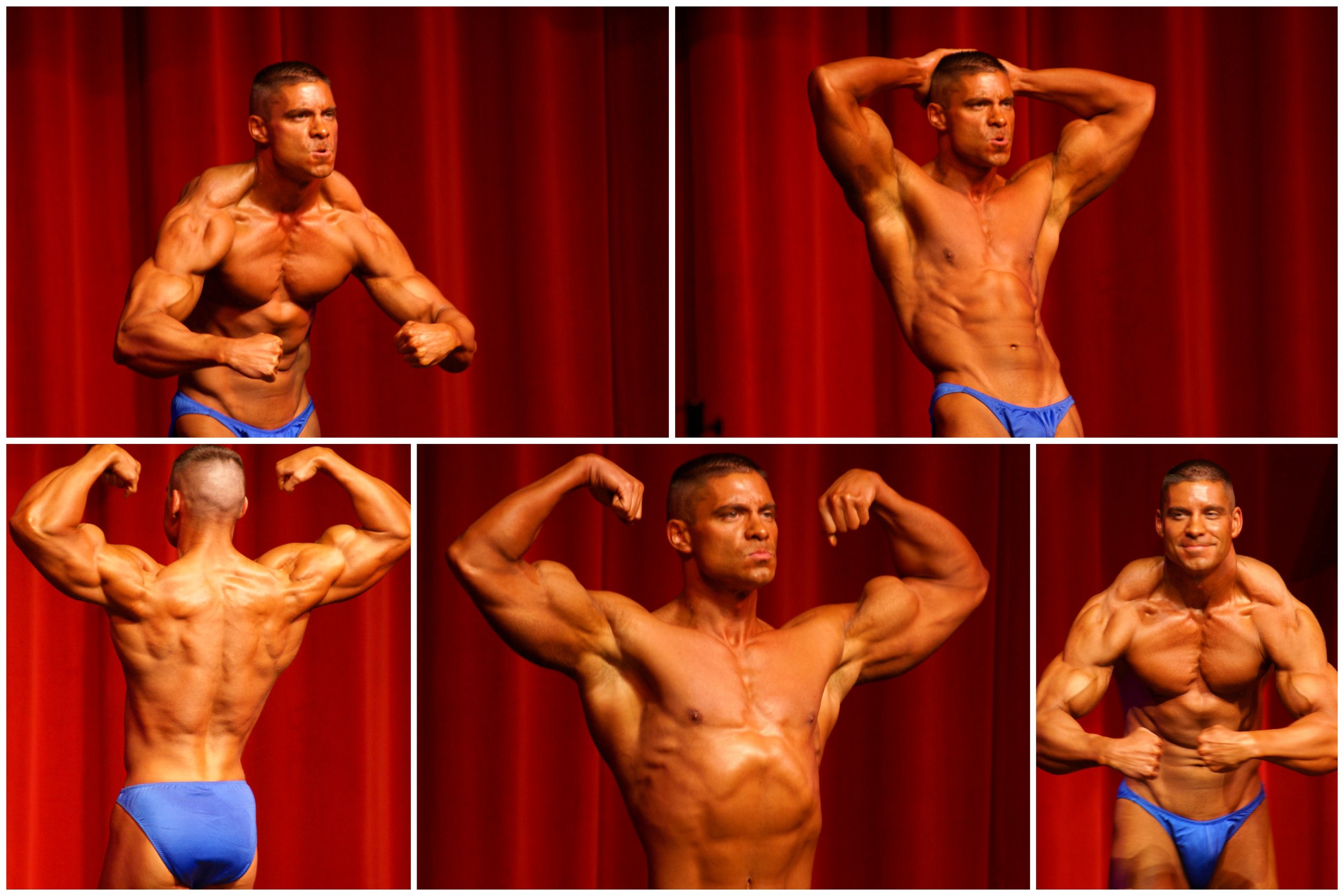
In the end, I found that I retained more of the muscle I had put on in the past two years and came in looking harder and more defined than at either previous show—which, of course, was the ultimate goal.
(I somehow managed to lose the video from this show.)
The 2011 NPC Grand Prix
I hadn’t planned on competing in 2011. As I said, I preferred to give myself two years between shows.
However, I was approached by another one of my fellow trainers where I worked, Julie, who wanted to try her hand at competing. She was good friends with Romy and also came from a soccer background, along with regular lifting.
She asked if I’d help train and prepare her for a show. I was excited to have the opportunity, as I knew her to be someone who, when she put her mind to anything, was unstoppable. I knew she was extremely coachable, and there was no reason she couldn’t do it.
As we began the process—deciding what event she’d compete in, the time frame, etc.—one thing dawned on me.
When I trained Romy for her show, I was competing too. That meant I could be backstage with her the entire day to help show her how to get through it.
The day of a show starts for many around 4 or 5 in the morning and can possibly go all the way until midnight. It’s a physically and mentally challenging day. You’re allowed to eat very little and only sip water. Too much food or water (and it takes very little in that depleted state) can make a very visible difference in how you look—and after 14 weeks, you don’t want to blow it on the day of the show.
Since only competitors are allowed in the back, if I was going to help Julie get through the day, there was only one way that was going to happen:
I was gonna have to get the posing trunks out and do it with her.
Julie went after the endeavor with all the gusto I knew she would. We practiced posing, picking out her posing music, choreographing her posing routine… These are all things that go into preparing for one of these events that people often don’t think about. People assume you just go up there, pose, and that’s it.
You have to not only learn how to hit the poses properly—the ones the judges are going to ask of you—but also have the strength to literally flex every muscle in your body for as long as the judges take to look at you. Depending on the size of the class you’re in and the level of competition, that could be anywhere from 30 seconds to 10 minutes.
We practiced this by spending an hour each night running through poses. The only way to get good at it is by doing it over and over, for as long as you can. Posing is deceptively exhausting—especially on the day of the show when you’re depleted of both food and water.
If you can’t hold your pose, and that happens to be the moment the judges look at you, then you’ve sold all the hard work you’ve put in short.
Judging aside, this is also when the photos are being taken—the measuring stick upon which we truly base our success.
Julie would go on to win second place in her class. I was very proud of both Romy and Julie and honored that they trusted me to help them take on this lofty endeavor.
Julie has since gone on to become the Director of Athletics at the University of Chicago.
Unbeknownst to me at the time, this would be my last bodybuilding competition to date, as I was unwittingly about to enter the world of professional wrestling…
This video is a deeper inside look into the preparation in the last few days leading up to the show, and the day of the show itself.